
Notes from the field: my second week at JII, training at the Accra photosynthesis hackathon
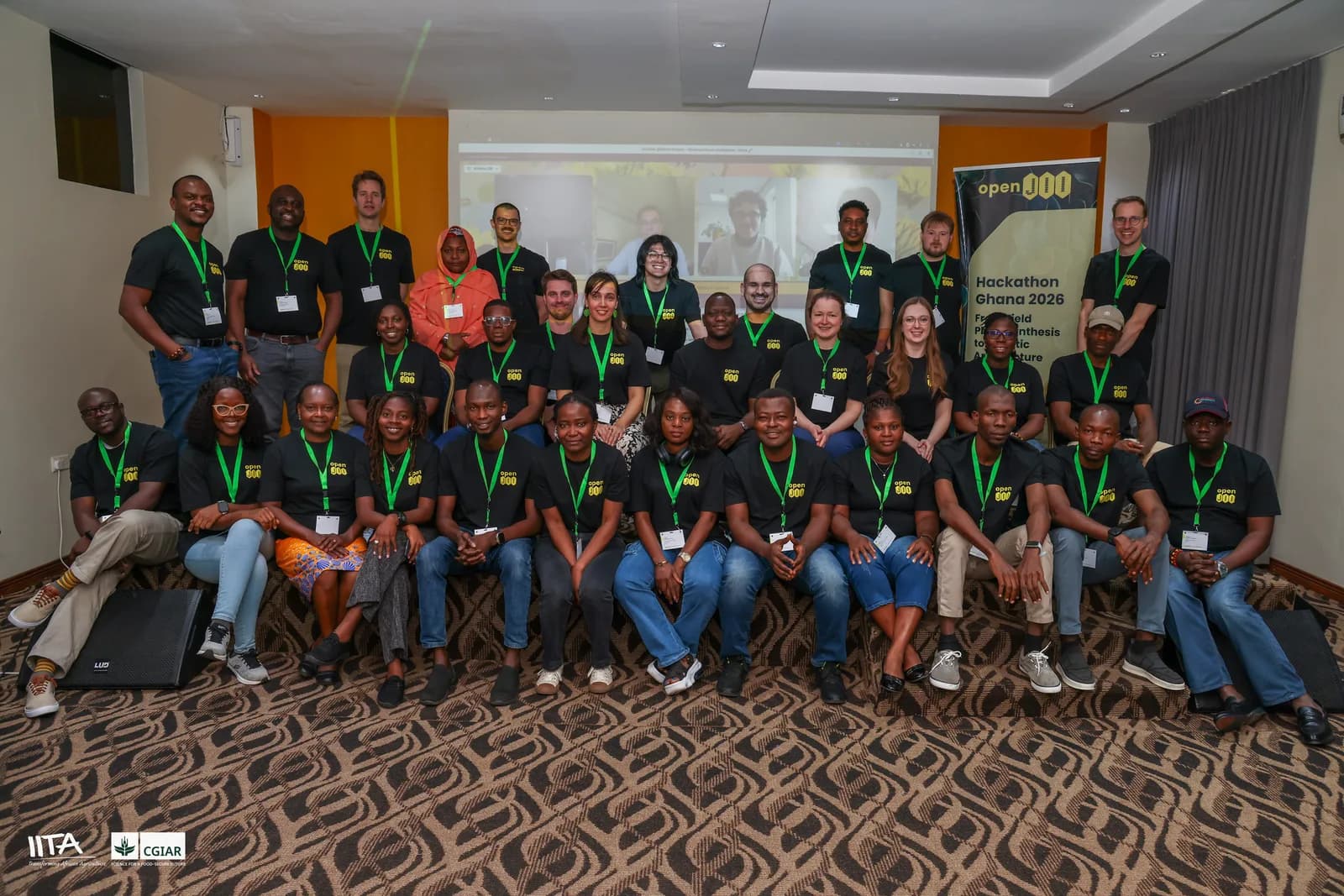
From 9 to 13 March 2026, the first dedicated photosynthesis hackathon ran in Accra, Ghana. It was hosted by IITA and organised between RWTH Aachen, the Jan IngenHousz Institute, the University of Cambridge, and IITA itself, with 35 participants drawn from 14 countries across Europe and Africa: data scientists, plant physiologists, geneticists, breeders, and bioinformaticians. I had been preparing for it from outside JII for a few months, and started full-time as JII’s Technical Program Manager just before flying out. Week two on the job. I was there as one of the trainers.
I cowrote the official reflection on the openJII blog with Jacky To. This is the more personal note: what stuck with me from the trainer side of the room, and what surprised me about the platform underneath.
Collaborative, not competitive
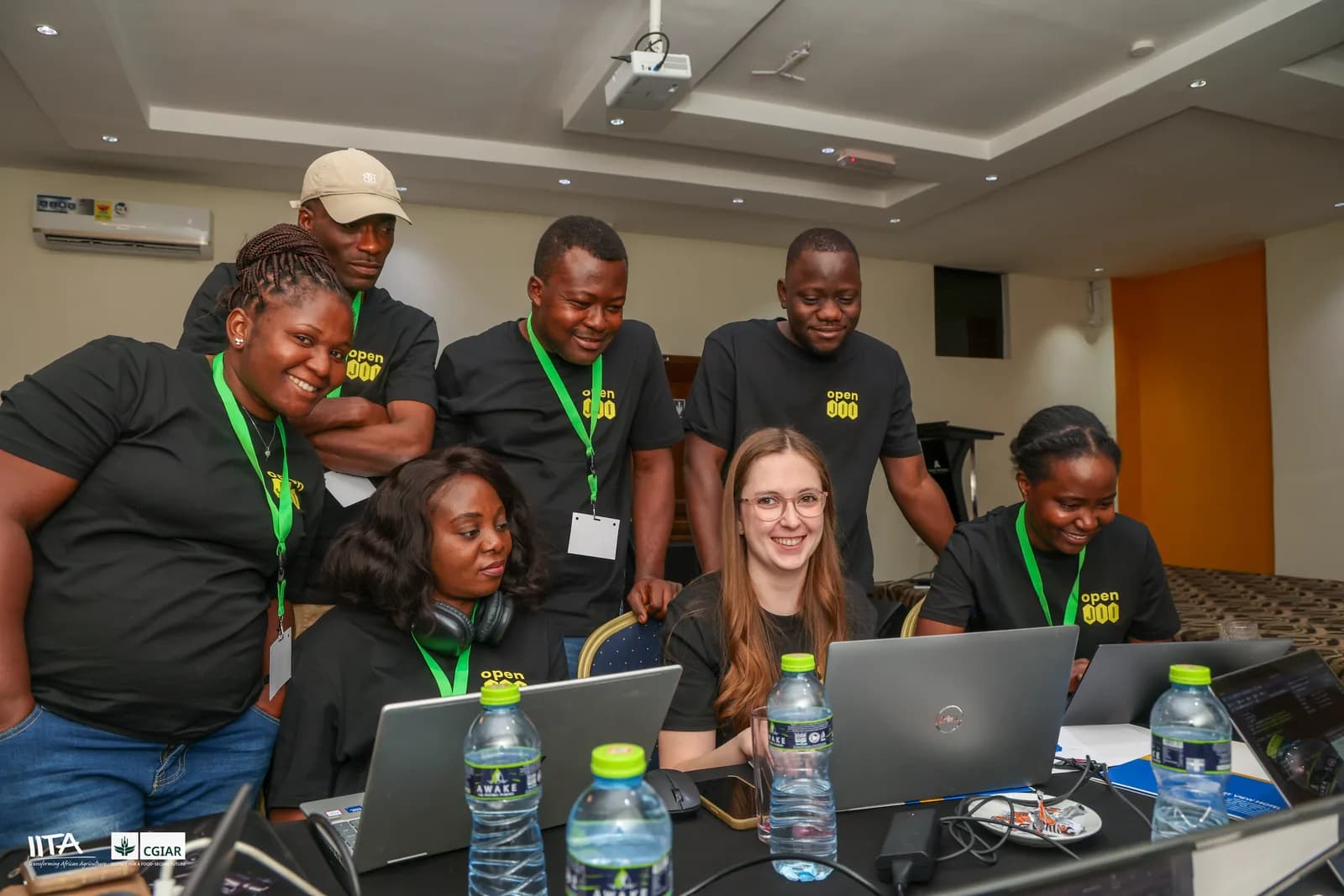
Most hackathons run on adrenaline and ranking. This one didn’t. Five interdisciplinary teams worked on shared field datasets (cowpea from Nigeria, barley from the Netherlands and Ethiopia, common bean and potato from the Netherlands) and presented progress to each other every day. Common obstacles got resolved in a corridor, not at a final-day judging panel. By day three, teams were openly comparing notes on the same dataset rather than guarding lines of attack, and that’s when the more interesting findings started to emerge.
The design choice paid off. Convergent findings across independent teams (different methods, different crops) carry much more weight than any single team’s result, and that convergence is what most of the participants will be co-authoring in the months after the event.
What teams actually found
Two threads stood out. First, several teams independently demonstrated that the temporal structure of photosynthesis measurements distinguishes genotypes more cleanly than canonical single-point parameters do. Looking at the trace itself, not just the extracted summaries, recovered genetic signal that standard analysis pipelines were quietly discarding. Second, multiple teams converged on previously underexplored portions of the fluorescence measurement (particularly later sections of the trace that no extraction pipeline currently uses) as the parts carrying the most heritable, breeding-relevant information.
The methodological corollary is uncomfortable for the field: the convention of compressing a rich time-resolved trace down to a handful of named scalar parameters is leaving a meaningful chunk of the genetic signal on the table. The hackathon didn’t prove this in a way that closes the question (that work is what the follow-on papers are for), but five teams independently arriving at variants of the same observation is hard to explain away.
Training plant breeders is humbling
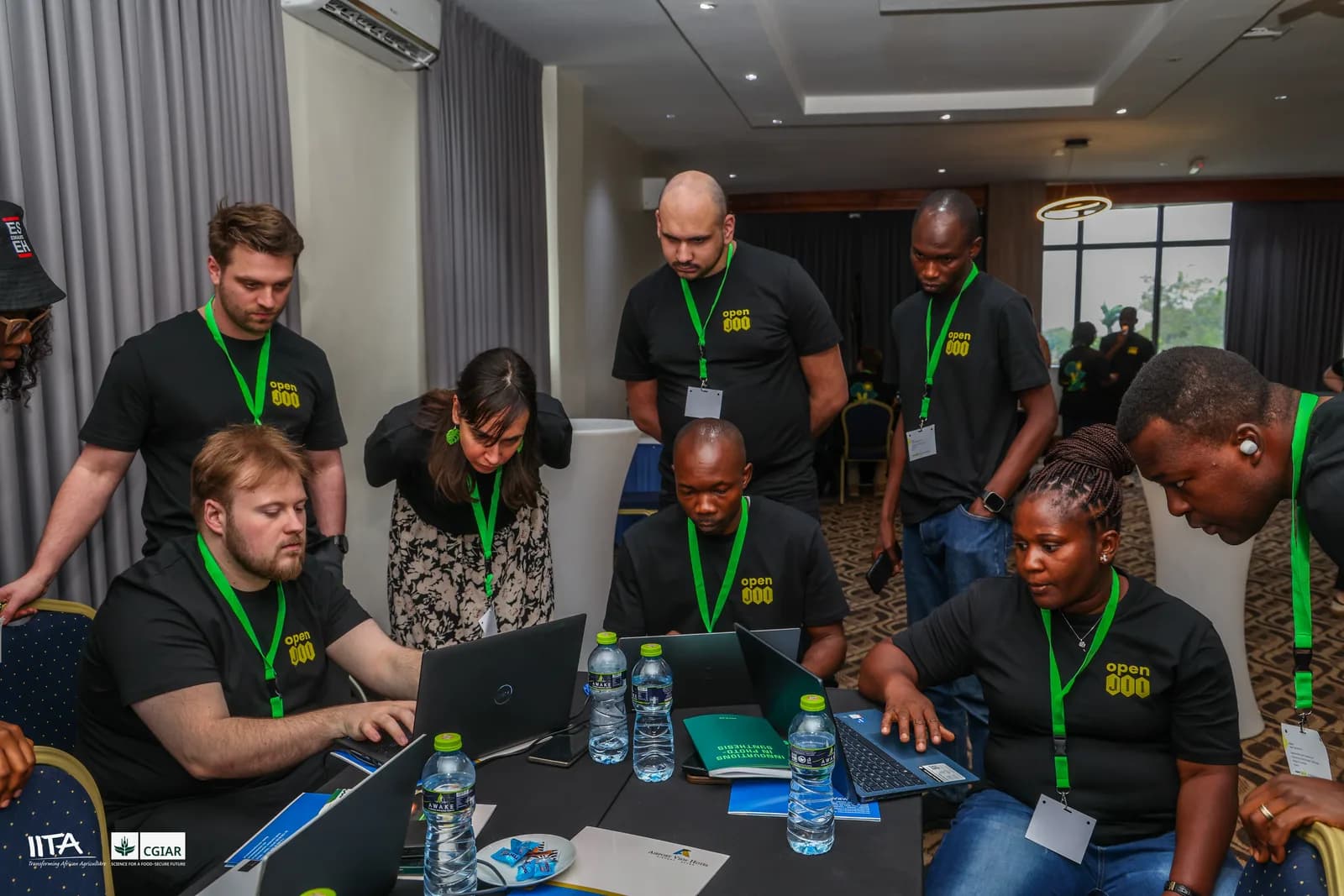
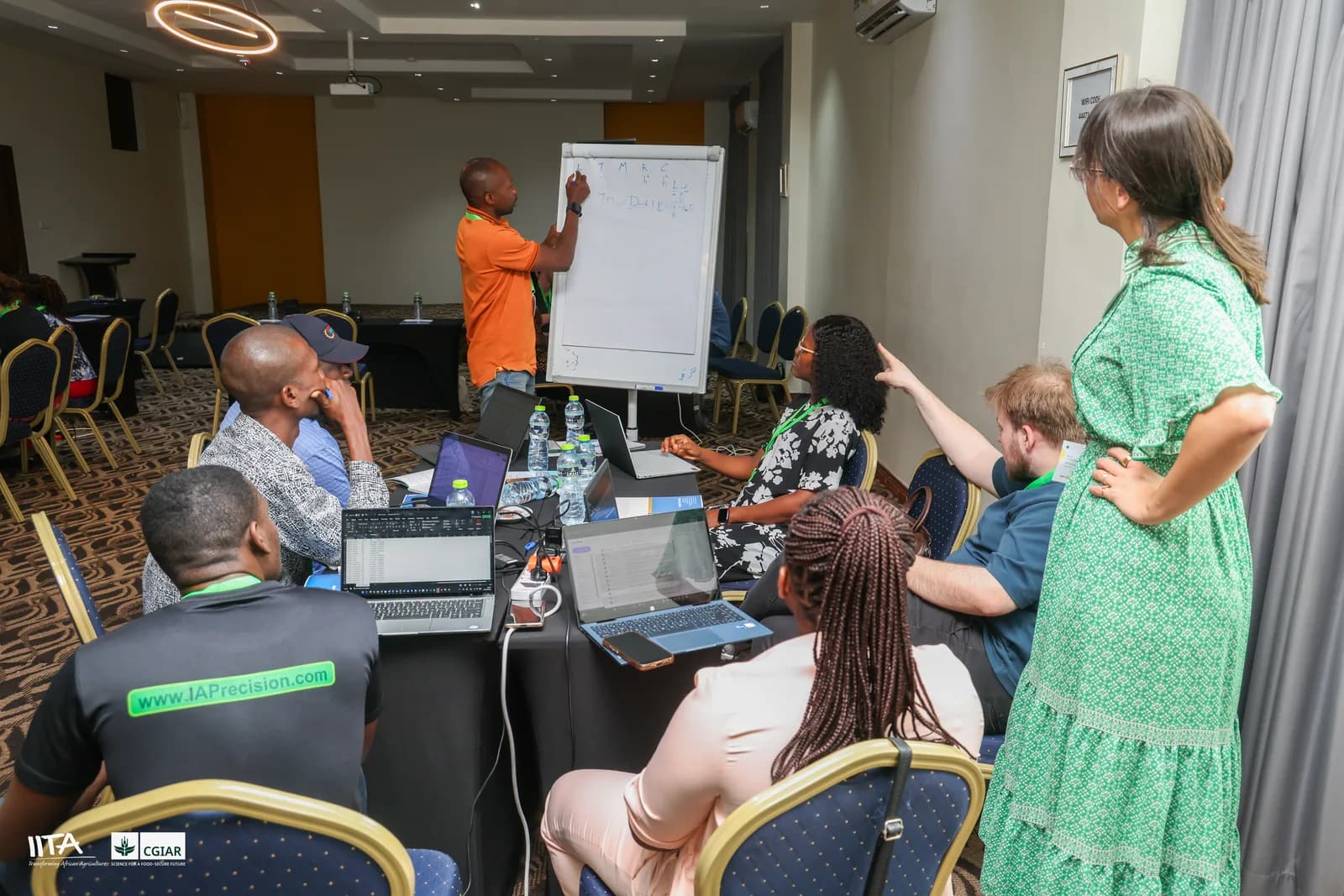
The thing nobody tells you about being a trainer at an event like this: the participants are usually smarter than you are about the domain. Plant breeders, crop physiologists, statisticians, data scientists; they all came in with deep field expertise and reasonable expectations of what the data should look like. My job wasn’t to lecture; it was to help them get unstuck on tooling, on dataset shapes, on the mechanics of an analysis pipeline they wanted to build, and on the messy real-world details of working with field measurement data. The good moments were when a participant asked a question I couldn’t answer immediately, and we worked it out at a whiteboard together.
That’s a useful pattern for anyone running training inside a research community. The framing isn’t teach the experts; it’s be the friction-reducer the experts need to do their best work. Bring the tools, the structure, and the willingness to be wrong out loud, and let the domain depth come from the room.
What the platform did quietly
The piece I’m proudest of, with my technical-program-manager hat on, is what didn’t happen at the start of the event. Every multi-team data hackathon I’ve been near has lost its first day or two to the dull friction of access: whose laptop sees which file, whose Python install can read which format, whose VPN is talking to whose data lake. We didn’t. Datasets were curated and delivered through openJII running on Databricks, and 35 people walked into a shared, zero-setup analytical environment from the first morning.
That’s not glamorous. It is, however, exactly the kind of platform-level work that compounds. The same lakehouse pattern that runs openJII’s silver and gold layers in production was the substrate for the event, which means the analytical workflows the teams built during the week aren’t throwaway. They live on the same infrastructure that will receive the next round of field data. The hackathon didn’t end on Friday so much as graduate.
This is the through-line for me, professionally. The data-platform practice I launched at INFO grew up around Databricks; an agritech digital-transformation engagement adopted it on my recommendation; openJII runs on it now; and an event like this is what it looks like when that decision is paying off in the room rather than on a slide.
What it meant for openJII
For openJII specifically, the event was an early proof of concept for what the platform exists to do: take field datasets across geographies and crops, give people sensible primitives to work on them, and step out of the way. The follow-on plans (co-authored documentation, regional African sensor hubs, dataset sharing through the open-science platform) are the things that turn a one-off hackathon into community infrastructure.
It’s an unusual way to start a job. But the week made clear what good would look like: the questions the participants were already asking are the questions the platform needs to be ready for.